Corduroy Dictionary
By Jeff Rothermel
December 20, 2025
Captain's Log:
The Century Dictionary
Published in the Year 1914
Not For Sale
(NFS)
[Update: SOLD on June 29, 2026]
The First World War occurred in the years 1914 - 1918. A book printed in Chicago around that time period caught my attention. Can you guess how many pages the book contains? [Answer at the bottom of essay.]
WARNING.
Exact Answer Status: Unknown.
Can you solve the mystery?

The Century Dictionary
Nine inches thick.
How many pages?

The book is not pretty, but it is incredibly interesting. The book weighs 25.30 pounds (roughly 11.48 kg). Its dimensions are approximately: 9"x12.25"x9" [measurements in inches]. The book was printed roughly 111 years ago, by a company that is still in existence, R. R. Donnelley & Sons. The book appears to have been re-bound with corduroy cloth covered boards. The original binder was J. F. Tapley Company (New York) or R. R. Donnelley & Sons (Chicago).

This mammoth book is interesting for a number of reasons. Rarely, will you see a book that can have both boards of the book lay flat (180 degrees). Such book gymnastics, breaks the spine of the book. This book shows the signs and scars of a good, hard life. Some of the pages are creased, a few have closed tears and there is even a taped repair from yesteryear.

Another fascinating factor concerning this book is what Americans chose to define and what had not yet entered the American lingo. The term "airplane" is not in the book. The term used was "aëroplane."

Today, "airport" is "a complex of runways and buildings for the takeoff, landing, and maintenance of civil aircraft, with facilities for passengers."[1.] During the eve of the First World War "airport" was a term used to define a structure in a building or a boat. It was "a small aperture out in the side of a vessel to admit light and air." Aërodome was the term used during the First World War for what we now call a military airfield. Aerial combat concepts were still developing at the time of the book, which explains why "aërodome" is not in the book. You can discover more about American First World War aviation in the 2017 Captain's Log:
Reviewing: Hostile Skies- A Combat History of the American Air Service in World War 1

Three pages of editors are listed as assisting in creating this book. The editor-in-chief had an expert in naval affairs, and another was listed as "military engineering and the art of war."


Before the First World War, the United States was arguably not yet a proven military powerhouse, though the foundation within American English language was solidifying with military "expert" editors. It is interesting to see the inclusion of American military editors. Today, the United States is known for its air power. The foreshadowing of what was known and not known is simply: fascinating. The perspectives back then were different than today. Catching a glimpse of language as America began to build industrial and military capabilities is a magical movement in time.

The first 7,046 pages (7.875 inches) of the dictionary are numbered. The book then has approximately 1.75" unnumbered pages called the Supplement. The letter "A" of the supplement contains forty-nine leaves (roughly 100 pages). John Carter defines a leaf as:
"LEAF. The basic bibliographical unit: the piece of paper comprising one page on its front side (recto, obverse) and another on its back (verso, revers). Leaf, leaves are abbreviated to 1., II, or f., ff. (from FOLIO). The inaccurate and slovenly misuse of page for leaf ... appears to be on the increase and should be pilloried when found. Nor will the bibliographer neglect the essential truth that any leaf is only part of the basic structural unit, the SHEET."[2.]
I'd estimate the book has roughly, 2,000 unnumbered pages. Internet booksellers inspect and describe the item they list online. This book is more than a simple: 7,046 pages in length. There are two blank leaves at the front of the book. Introductions are often in roman numerals. Bookdealers often list the last sequence number. The process is called PAGINATION.[3.]
"PAGINATION. The sequence of figures with which the pages of a book are numbered. These are known individually as page-numerals, collectively as pagination."[4.]
THE CENTURY DICTIONARY AN ENCLOPEDIC LEXICON OF THE ENGLISH LANGUAGE Revised and Enlarged Edition. Edited by William Dwight Whitney and Benjamin E. Smith. New York: Century Company, 1914. [4, blank], xii, 7,046pp., [estimated 2,000 unnumbered pages "The Century Dictionary Supplement"], 28pp., [4, blank].
This book is missing the insets. Said another way, there are no color illustrations inside this book.
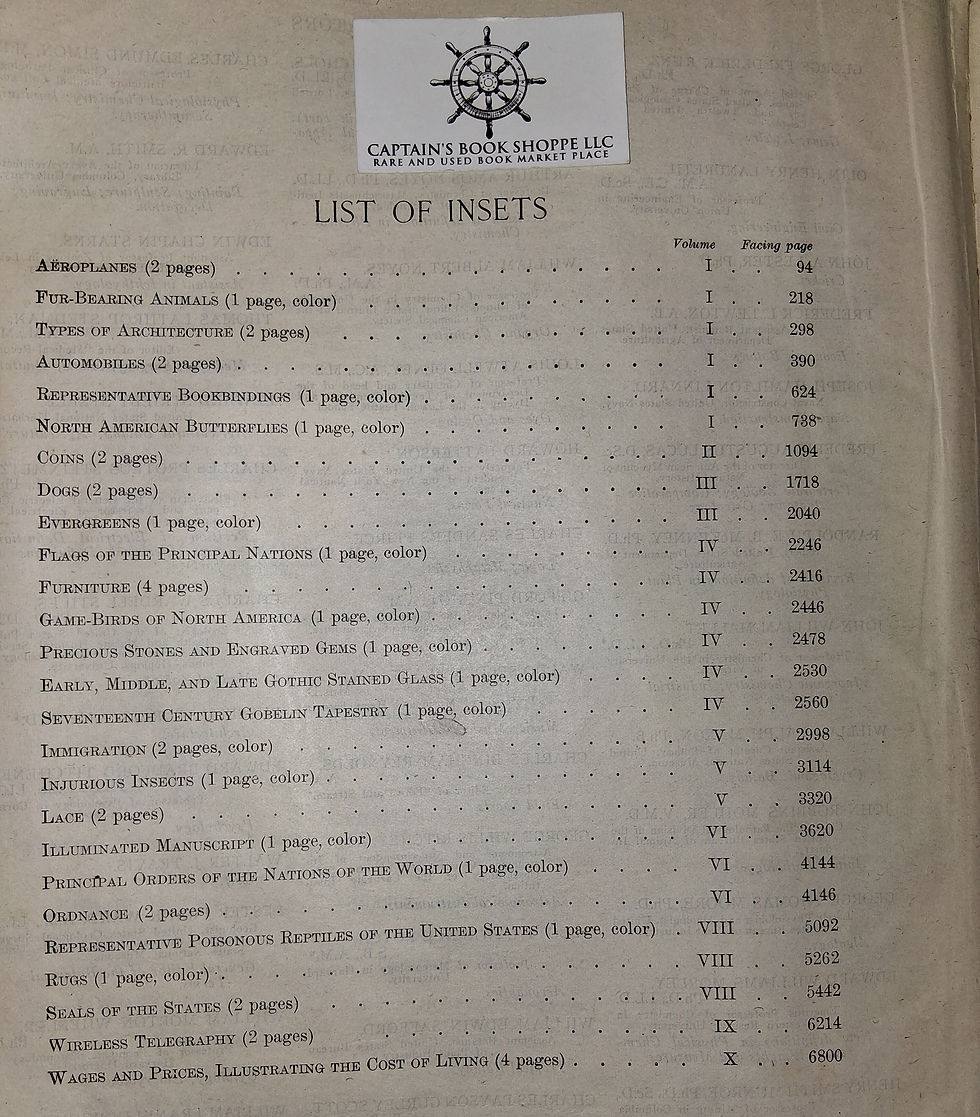
The roughly thirty pounds of shipping weight, lack of color illustrations, creased and taped pages are some of the factors that casts this corduroy rebound book into something that sits in the bookstore and is not listed for online sale. If you send me a text or email and ask me how much the book is, the answer is simple:
Not For Sale
(NFS)
This battered book is fascinating. It is doubtful that I will ever let go of this treasure. Then again, when it is time to pay the bookstore rent, who knows?
Walk in the store, make an offer, and you may just do a cash and carry.
Update: On June 29, 2026, the book was sold.
Estimated number of pages: 9,024

End Chapter One of the Corduroy Chapters.
=====Notes
[1.] Definition of Airport. airport definition - Google Search (Source: Googlelanguages Oxford Dictionary, Accessed December 20, 2025.)
[2.] John Carter. John Carter's ABC for Book Collectors Ninth Edition, Illustrated. Revised by Nicolas Barker and Simran Thadani. New Castle, Delaware: Oak Knowll Press, 2016, 158.
[3.] Laurence Worms. Cataloguing for Booksellers, A Guide for the Rare Book Trade. London: Rare Book Society, 2023, 31-3.
[4.] Carter, 179.


I found this article extremely useful and informative, especially for students who are planning to pursue higher education abroad for the first time. There are many things students need to consider before making such an important decision, including academic eligibility, university reputation, affordability, career opportunities, scholarships, and visa requirements. The practical information shared here can help students understand the process more clearly and plan ahead with greater confidence. Students looking for additional counselling and application support can also explore WTS Study Abroad Consultants for guidance throughout their international education journey. Thanks for sharing such valuable information.
This post about the Corduroy Dictionary is a fun reminder of how language and books can be creative, playful, and meaningful at the same time, especially when they help readers connect with learning in a simple way. I think content like this keeps reading enjoyable for all ages. I recently came across liability insurance Dallas TX cheap while comparing different options, and it reminded me how important it is to carefully review choices before making decisions. Good research always helps reduce costs and avoid future problems.
It’s always interesting to see creative takes on classic children’s literature like Corduroy, especially when paired with playful interpretations such as a themed dictionary. Standard 7: Privacy and Dignity Workbook Answers It adds a fun and engaging layer that can help young readers connect more deeply with the story and its characters.
The way the article treats the idea of a “Corduroy Dictionary” really stood out to me, especially how it plays with language and childhood memory in a way that feels both playful and slightly nostalgic rather than strictly informational. It makes me think about how even simple words or familiar textures can carry so much emotional weight when they’re framed in a creative context like this, almost turning everyday language into something more personal and reflective. I also found myself wondering who the intended reader is meant to be here—whether it’s more for children, adults revisiting childhood themes, or a mix of both, because it seems to sit somewhere in between. In a broader sense, it’s interesting how structuring ideas…
This post genuinely made me pause — the idea that "airport" once meant a small opening in a ship's hull is the kind of linguistic detail you'd never stumble across unless someone dug it out of a 111-year-old dictionary. It's fascinating how much the English language was still finding its feet on the eve of the First World War. As a student who's currently working through some Finance Dissertation Topics with support from New Assignment Help UK, I'm constantly reminded how important it is to trace the origins of terminology rather than taking modern definitions for granted. That shift from "aëroplane" to "airplane" is a small but powerful example of exactly that. The corduroy rebinding and battle scars on this…