Deceptive Language
- Apr 14
- 7 min read
by Jeffrey A. Rothermel
April 14, 2026
Chapter Three
Captain's Log:
The Corduroy Dictionary Chapters
Deceptive Language
A single English word can have multiple meanings. I was reminded of such language complexities this past week. The following story concerns my jumping into the dictionary rabbit hole. The duplicity of American English continued to unfold as I considered the significance of a 1943 dictionary this past weekend.
I knew better than to jump but jump - I did. You are advised not to follow or read on. Though, it is April 14th. It was on this day in 1828 that Noah Webster copyrighted his first dictionary... ... ...
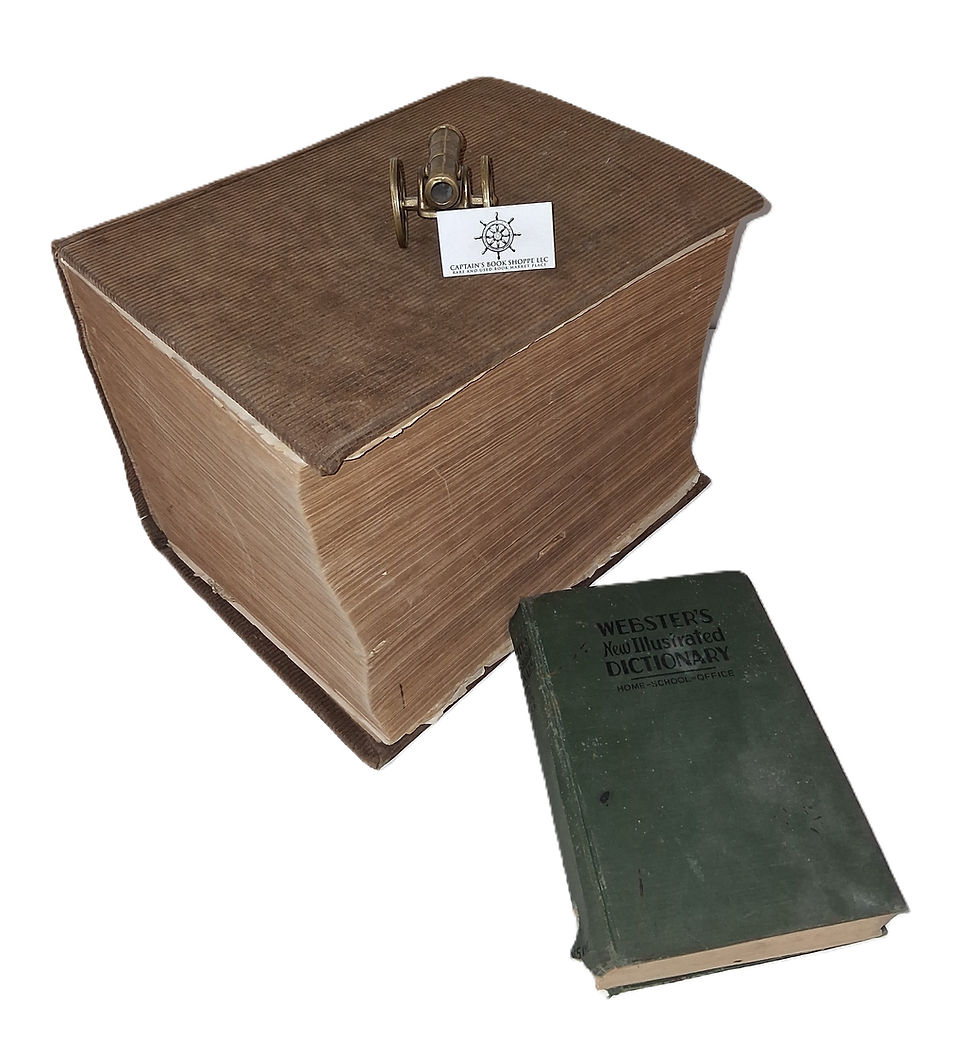
Large brown book published in 1914. Average sized green book published in 1943.
Words with double meaning are all around us. Booksellers consider the word illustrated to mean a book "containing drawings, photographs or other illustrations." [1.] It comes as no surprise that during the Second World War, at least one illustrated dictionary rationed its illustrations. This past Saturday, I was sorting and culling through a collection of old books. I found a 370-page illustrated 1943 book that lacked illustrations. Such an instance generally means the illustrated plates were cannibalized (removed) from the book. The more that I examined the book, the more I became convinced that the book never had plates. IOBA defines a plate as: "a special page containing an illustration or other extra information. Usually produced on higher quality paper and unprinted on the reverse."[2.] There are artists, crafters, and collectors that purchase battered books for the paper artwork that can be repurposed. Bookbinders may repair the book. Scholars want original and reprinted items for other reasons. As a bookseller, I search for the redeeming qualities when I come upon a sickly, weathered book. I ask myself: can it be saved?
Should this green book be saved?
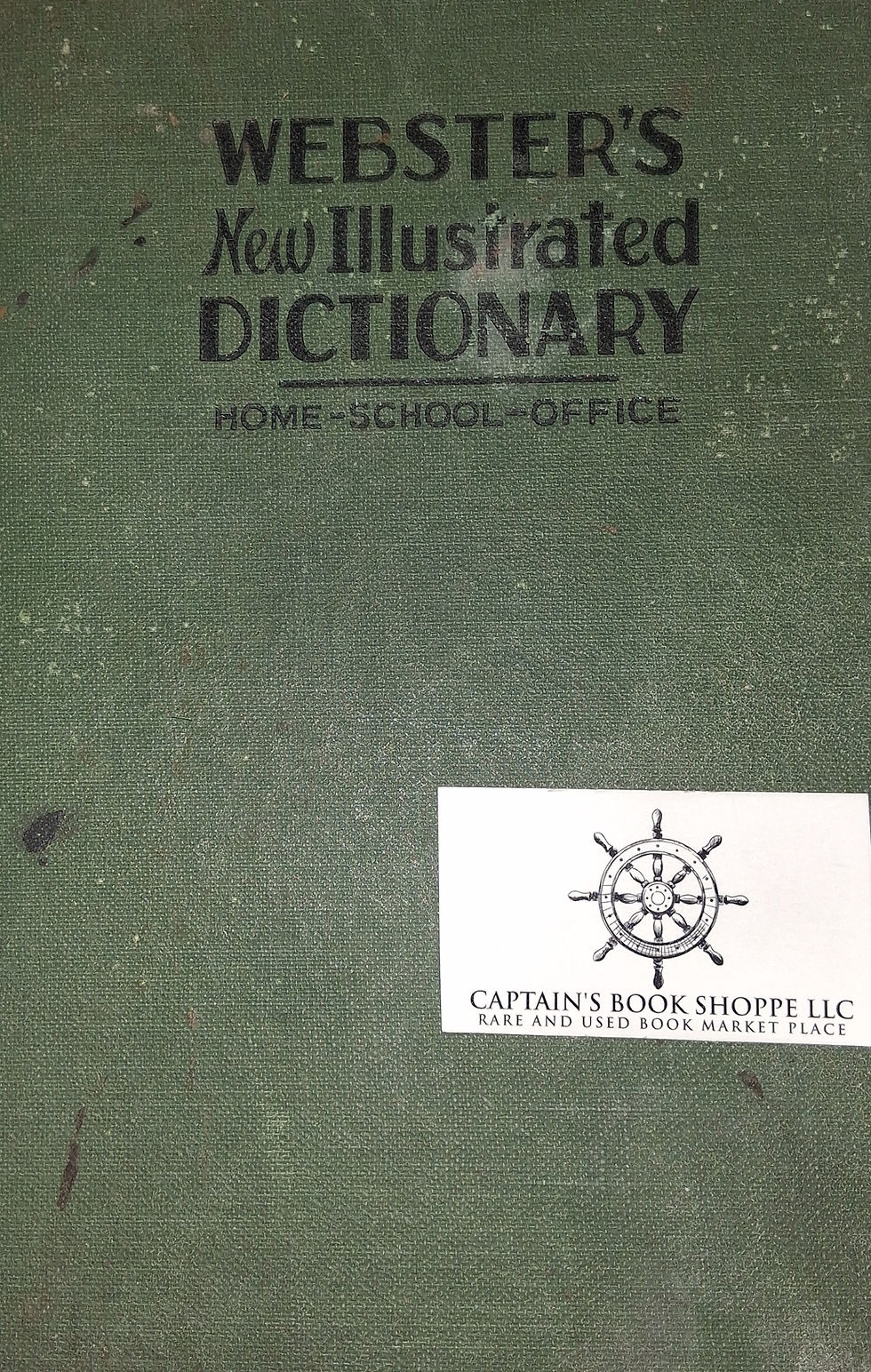
The battered green Webster's Dictionary was one of the most distressed dictionaries that I had seen in a long while. I instantly pre-judged it as recycling-scrap due to soiled boards and a bad book spine. It did say "illustrated" so I decided to look a bit deeper...
Books in rough condition can occasionally transition to another level due to their printed artwork.
Eureka, I had found an illustrated book that was not illustrated! I thought to myself: "somebody will find this non-illustrated - illustrated book to be interesting." Then I found five small black and white illustrations in the 370-page book. It caused me to wonder more about the book...
The bottom line. Do publishers need only a few illustrations to call the book illustrated? The following essay highlights a few rabbit holes one explores when dealing with deceptive language. The answer will be up to you to decide.
WEBSTERS NEW ILLUSTRATED DICTIONARY
_____
HOME - SCHOOL - OFFICE
Twenty-five of the twenty-six sections lack illustrations. (Letters "B" - "Z" have zero illustrations.) Hidden in the first section "A" are five small drawings. They are of the aardvark (p.1), abacus (p.1), acanthus (p. 5), accordion (p. 6), acorn (p.7).

COLD CASE
WEBSTER'S NEW ILLUSTRATED DICTIONARY
1939
Why the editors of the 1943 green book did not publish illustrations for sections B - Z remains a perplexing question.
While I have a few theories, I have not come to any definitive conclusions. Therefore, the green book now resides on the COLD CASE BOOKSHELF in Area 52.
A sentence on the title page goes back to a 1909 court case involving dictionaries. The statement in our green 1934 book says:
"This dictionary is not published by the original publishers of Webster’s Dictionary or by their successors."
The man credited with being the father of the American Dictionary is Noah Webster (1758 - 1843). As a lexicographer, (writer, compiler, and editor of dictionaries), he standardized spelling and pronunciation of American English. He "published five dictionaries, six textbooks, an American English version of the Bible, six other books, and had edited one magazine and two newspapers."[3.] Noah Webster's original dictionary was published in 1828 and called the American Dictionary of the English Language.
"Merriam-Webster can be considered the direct lexicographical heir of Noah Webster. In 1843, the company [known as G. & C. Merriam Co.] bought the rights to the 1841 edition of Webster's magnum opus, An American Dictionary of the English Language, Corrected and Enlarged. At the same time, they secured the rights to create revised editions of the work."[4.]
A series of court cases occurred over the name Webster. A 1909 federal court ruling mandated the statement: "This dictionary is not published by the original publishers of Webster’s Dictionary or by their successors."[5.] The branding of American English had been so effective, people associated an American English dictionary as a Webster Dictionary. Businesses not associated with Webster could use the term: Webster as long as the above statement was used.

The backside of the title page is the copyright page.

The copyright page states: "WEBSTER'S NEW ILLUSTRATED DICTIONARY FIRST PUBLISHED AND COPYRIGHTED, 1939, 1943, BY BOOKS INC."
I suspect some of the clues for eventually solving this COLD CASE rest with the 1939 version. My current theory is that the 1939 copyrighted copy on the eve of WWII probably had illustrations in all of the sections. As resources became more constrained during the war, the publishers opted to cut to save on cost. I suspect a removal of illustrations in sections B - Z called for a new copyright. Thus, Books Inc. secured a 1943 copyright.
If I ever stumble upon a 1939 Books, Inc. copy of WEBSTER'S NEW ILLUSTRATED DICTIONARY, I may be able to confirm or deny that theory as valid or invalid. Until then, the book gets placed in the cold case section of the business, storage area 52.
Oddly, page 154 of the green book states:
"*illustrate (il’ us trᾱt), v.t. to make clear, to explain by examples; to adorn, as a book with picture."[6.]
What is known is that Helen Smith's name was written in the book in three different places. Each time the name had different handwriting as if the young Helen's penmanship was improving over time. While the publisher provided few illustrations, someone opted to illustrate the book in multiple places. I suspect the young artist may have been Helen Smith. My opinion is that the doodles in the book are more interesting than the publisher's illustrations. I consider Helen the illustrator.

Switching subjects back to previous Corduroy Book Chapters, we return to the subject of the AIRPLANE. The small green book does have the term: "airplane: (ᾴr plᾱn), n. a heavier than air motor-driven form of aircraft, supported by the action of air against the wing planes."[7.] An oddity is that the large 1914 brown corduroy dictionary did not have the term "airplane" but had drawings of the "aëroplane."

The large brown corduroy book should have also had two color plates depicting aëroplanes, but they are missing. Determining if anything has been removed from a book is an important step/process.

I consider the twenty-five-pound corduroy book to be illustrated. It has roughly a thousand illustrations. Oddly, "illustration" or "Webster" is not included in the title of the book. It is titled:
THE CENTURY DICTIONARY AN ENCLOPEDIC LEXICON OF THE ENGLISH LANGUAGE Revised and Enlarged Edition. Edited by William Dwight Whitney and Benjamin E. Smith. New York: Century Company, 1914.
The average sized green book is something I do not consider illustrated, but the title states:
WEBSTER'S NEW ILLUSTRATED DICTIONARY Composite edition, Especially Compiled for Home, School, and Office Use. Boston: BOOKS, INC., 1943.
The smaller green book would have been more practical to carry back and forth to school and home.
Ideally, at some point in the near future I will pull the green book off the COLD CASE bookshelf in Area 52 and get resolution to the questions surrounding this book. Though, it is more likely that when I am dead and gone a book prospector will be going through Area 52. They will come upon the tattered green book. Now, you know at least part of its story. This story is an example of the types of rabbit holes that I travel when investigating a book. When I pick up an American Dictionary, I tend to check for the term airplane or computer. I find myself wondering how society thought of those things before my time.
Dictionaries have almost all the words for any story. How we put them together is what makes the story. Witnessing the human products of synthesizing collective knowledge into various books over time is fascinating. Each person looks upon a book from their own perspective. Should you have answers or additional clues to solving this case, I welcome a phone call during business hours: (319) 351-3166. You are also welcome to send me an email at: Jeffrey@CaptainsBookShoppe.com
Corduroy Dictionary Chapters
As a footnote in history, Noah Webster copyrighted his dictionary on April 14, 1828. [8.]
= = = = = FOOTNOTES.
[1.] Independent Online Booksellers Association (IOBA) book terminology.
ILLUSTRATED (IL, ILLUS) (Accessed April 12,2026).
[2.] Independent Online Booksellers Association (IOBA) book terminology.
PLATE (Accessed April 12, 2026).
[3.] Maryellen Smith. Copyright Lore. The Father of the Copyright. U.S. Copyright Office. April 2006., p. 12. Notices 2006_04.indd Copyright Lore: (Accessed April 13, 2026)
[4.] About Us | Merriam-Webster (Accessed April 13, 2026).
[5.] Webster Loses Its Trademark · Hardly Harmless Drudgery: Landmarks in English Lexicography · Grolier Club Exhibitions (Accessed April 13, 2026)
[6.] Source: Webster, Noah and Edward N. Teal eds. WEBSTER'S NEW ILLUSTRATEDDICTIONARY Composite edition, Especially Compiled for Home, School, and Office Use. Boston: BOOKS, INC., 1943. p. 154.
[7.] Source: Webster, Noah and Edward N. Teal eds. WEBSTER'S NEW ILLUSTRATEDDICTIONARY Composite edition, Especially Compiled for Home, School, and Office Use. Boston: BOOKS, INC., 1943. p. 12.
"ENTRIES preceded by a star are words often mispronounced or pronounced in different ways by different authorities." (Unnumbered page, following the copyright page under "PRONUNCIATION.") WEBSTER'S NEW ILLUSTRATED DICTIONARY Composite edition, Especially Compiled for Home, School, and Office Use. Boston: BOOKS, INC., 1943.
[8.] https://www.ebsco.com/research-starters/history/noah-webster-copyrights-his-dictionary (Accessed April 13, 2026).
= = = = =
Links to digital copies of Wester's New Illustrated Dictionary
Year: 1891, color plates front of book. No illustrations in Section "A." Published by Emerson & Company, Chicago.
= = = = =
Internet Resources
Webster Loses Its Trademark · Hardly Harmless Drudgery: Landmarks in English Lexicography · Grolier Club Exhibitions (Accessed April 13, 2026)
The Nationalist Roots of ‘Merriam-Webster’s Dictionary’ (Accessed April 13, 2026)
Notices 2006_04.indd Copyright Lore: (Accessed April 13, 2026)
Noah Webster Copyrights His Dictionary | History | Research Starters | EBSCO Research (Accessed April 13, 2026)
https://www.ebsco.com/research-starters/history/noah-webster-copyrights-his-dictionary (Accessed April 13, 2026).
= = = = = END


Comments